
One fellowship-trained bariatric surgeon, Dr. Reza Keshavarzi, plans your bypass, performs it and stays reachable on his own cell phone while you recover.
Gastric bypass, usually performed as a Roux-en-Y bypass, makes the stomach smaller and shortens the path food takes through the intestine. Dr. K performs it laparoscopically through small incisions, the minimally invasive approach he trained in during his bariatric fellowship.
The upper stomach is sealed off into a small pouch. You feel full after a few bites, so meals naturally get smaller.
The pouch is joined directly to a lower section of the small intestine. Fewer calories are absorbed because food skips the first stretch.
The new route changes gut hormones tied to hunger and blood sugar. This is why bypass is often considered for patients with type 2 diabetes.
The rest of your stomach stays in place. It is bypassed, not removed, which is the core difference from the gastric sleeve.
Dr. K performs bypass, the sleeve, ESG and the ORBERA balloon himself, so no single operation is the default. He matches the procedure to your health history.
Sometimes the right plan pairs surgery with GLP-1 medication and nutrition coaching.
Dr. K on matching medication, surgery and support to each patient.
| Procedure | What changes | Often a fit when |
|---|---|---|
| Gastric Bypass This page | A small pouch is connected to a lower part of the small intestine, reducing both portions and absorption. | Type 2 diabetes, persistent acid reflux or a larger amount of weight to lose is involved. |
| Gastric Sleeve | Most of the stomach is removed, leaving a narrow tube. The intestine is left as it is. | You want substantial weight loss with a simpler change to your anatomy. |
| Endoscopic Sleeve Gastroplasty | Sutures placed through an endoscope narrow the stomach from inside, with no incisions. | You prefer to avoid surgery. |
| ORBERA Gastric Balloon | A temporary balloon fills part of the stomach so you feel full sooner. | You want a nonsurgical start for moderate weight loss. |
Bypass asks more of you long term than the sleeve, so Dr. K recommends it when its strengths match your health. You leave your consultation knowing which procedure he recommends and why.
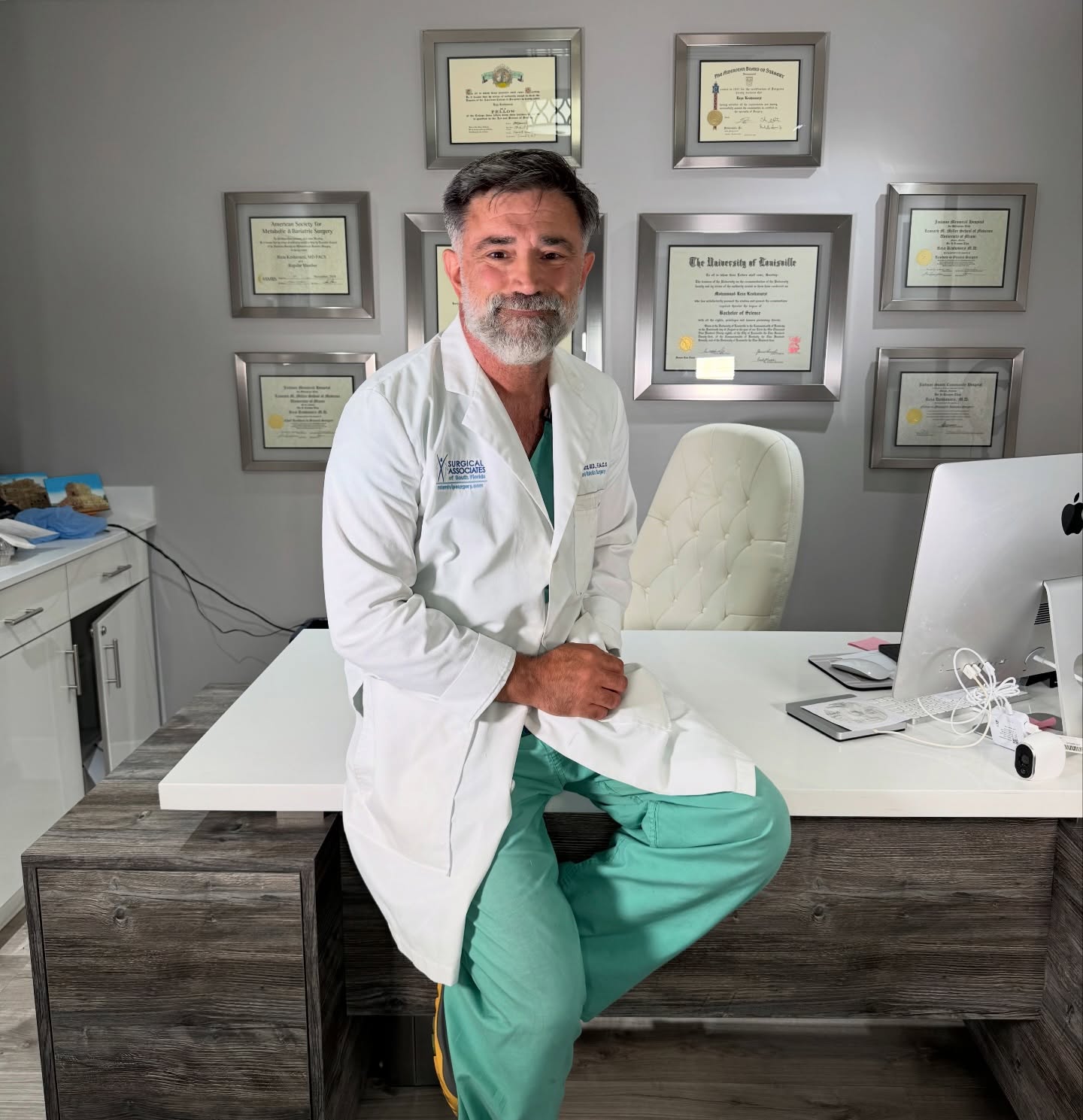
MD, FACS, FASMBS. Board-certified bariatric surgeon.
Dr. K has decades of experience in bariatric and minimally invasive surgery. He completed his surgical residency at Jackson Memorial Hospital and a fellowship in laparoscopic, bariatric and robotic surgery at Jackson South Medical Center.
He meets you at consultation, performs your operation and leads your follow-up. After surgery, patients reach him directly on his cell phone.
Filmed in our office, Dr. K answers quick questions on surgery versus weight loss medication. Hear how he talks with patients before you meet him.
How soon you reach a surgery date depends mostly on how quickly your pre-op testing is finished, and our team helps you through it.
Dr. K reviews your history, goals and past attempts, then explains whether bypass or another option fits better.
Medical clearances and an upper endoscopy, or EGD. Dr. K can perform it, or a recent one from elsewhere may be used.
A pre-surgery diet gets your body ready. Weight loss injections stop at least 2 weeks before surgery.
Your bypass is done through small incisions, followed by a short hospital stay as you start walking and sipping liquids.
Most patients return to work in 4 to 7 days and lift nothing over 20 pounds while healing. Diet stages and follow-up visits continue.
★★★★★"He has been there the whole process, provided his cell phone to make sure he could be reached at all hours."
YesiGoogle review
★★★★★"Mari was also a lot of help, she explained the diet thoroughly and was always happy to help."
Mikey MarteGoogle review
★★★★★"From the moment I walked into his office my life changed for the better."
Glorivee GonzalezGoogle review
4.9 out of 5 from 80 Google reviews
Your quote is given at your consultation, once Dr. K confirms bypass is right for you, along with what it covers.
If Dr. K performs your pre-op endoscopy, the procedure is included in your surgical cost and only the hospital fee is billed separately.
For 24 months, with monthly payments as low as $320
 Spread the cost of surgery into monthly payments.
Approval starts with a consultation where Dr. K reviews your weight history, related conditions such as diabetes or reflux, and earlier weight loss attempts. If he recommends bypass, medical clearances, an endoscopy and a pre-surgery diet prepare you for a surgery date.
Coverage for weight loss surgery varies from plan to plan, including among Florida Medicaid plans, so it depends on your specific policy. Bring your coverage questions to your consultation, where we also explain financing.
For many patients the value is measured in health as much as pounds, since bypass is often chosen when diabetes, reflux, high blood pressure or sleep apnea are involved. It also means lifelong vitamins and follow-up, and Dr. K will tell you plainly whether another option suits you better.
Yes. Because food skips part of the small intestine, you absorb fewer vitamins and minerals, so daily supplements and periodic lab work become routine.
Every visit takes place at our South Miami office, with the same surgeon at each step. Between visits, many questions can be handled by text message, and Dr. K stays reachable by cell phone after surgery.
Miami Gardens patients are seen at our South Miami office on SW 62nd Place for consultation, pre-op planning and every follow-up visit after bypass.