
Dr. Reza Keshavarzi, a fellowship-trained bariatric and metabolic surgeon, plans and performs your bypass himself and keeps guiding your progress long after surgery day.
Gastric bypass changes both how much you can eat and how your body handles food. Dr. K creates a small stomach pouch and connects it directly to a lower section of the small intestine, so food skips most of the stomach and the first stretch of intestine.
The operation is done laparoscopically, through several small incisions rather than one large opening.
The new pouch holds a small portion, so you feel full after a few bites. The rest of the stomach stays in place but no longer receives food.
Food travels from the pouch straight into the lower small intestine, which reduces how many calories your body absorbs from each meal.
Bypassing part of the digestive tract shifts the gut hormones that drive hunger and blood sugar. This is why bypass is often considered for type 2 diabetes.
Bypass is a metabolic operation as much as a weight loss one. It tends to fit patients whose weight is tied to health conditions that diet and medication have not resolved.
Not every patient needs a bypass. Dr. K also performs gastric sleeve, the low BMI Mini Sleeve, endoscopic sleeve gastroplasty and the ORBERA balloon, so his recommendation follows your health rather than a single procedure.
The choice is rarely surgery or medication. Dr. K builds plans that can combine GLP-1 medication, bariatric surgery, nutrition coaching and psychological support.
| Gastric Bypass | Gastric Sleeve | GLP-1 Medication | |
|---|---|---|---|
| How it works | Small stomach pouch plus a rerouted small intestine | Most of the stomach is removed, leaving a narrow sleeve | Injection that lowers appetite while you take it |
| Surgery | Yes, laparoscopic | Yes, laparoscopic | No |
| Changes absorption | Yes | No | No |
| Often chosen for | Type 2 diabetes, frequent reflux, higher weight | A simpler operation with no intestinal rerouting | Starting without surgery, or support before and after it |
| Before surgery | Clearances, EGD and a pre-surgery diet | Clearances, EGD and a pre-surgery diet | Stopped at least 2 weeks before any operation |
Already on a weight loss injection? You can keep it in your plan. It simply pauses at least two weeks before surgery.
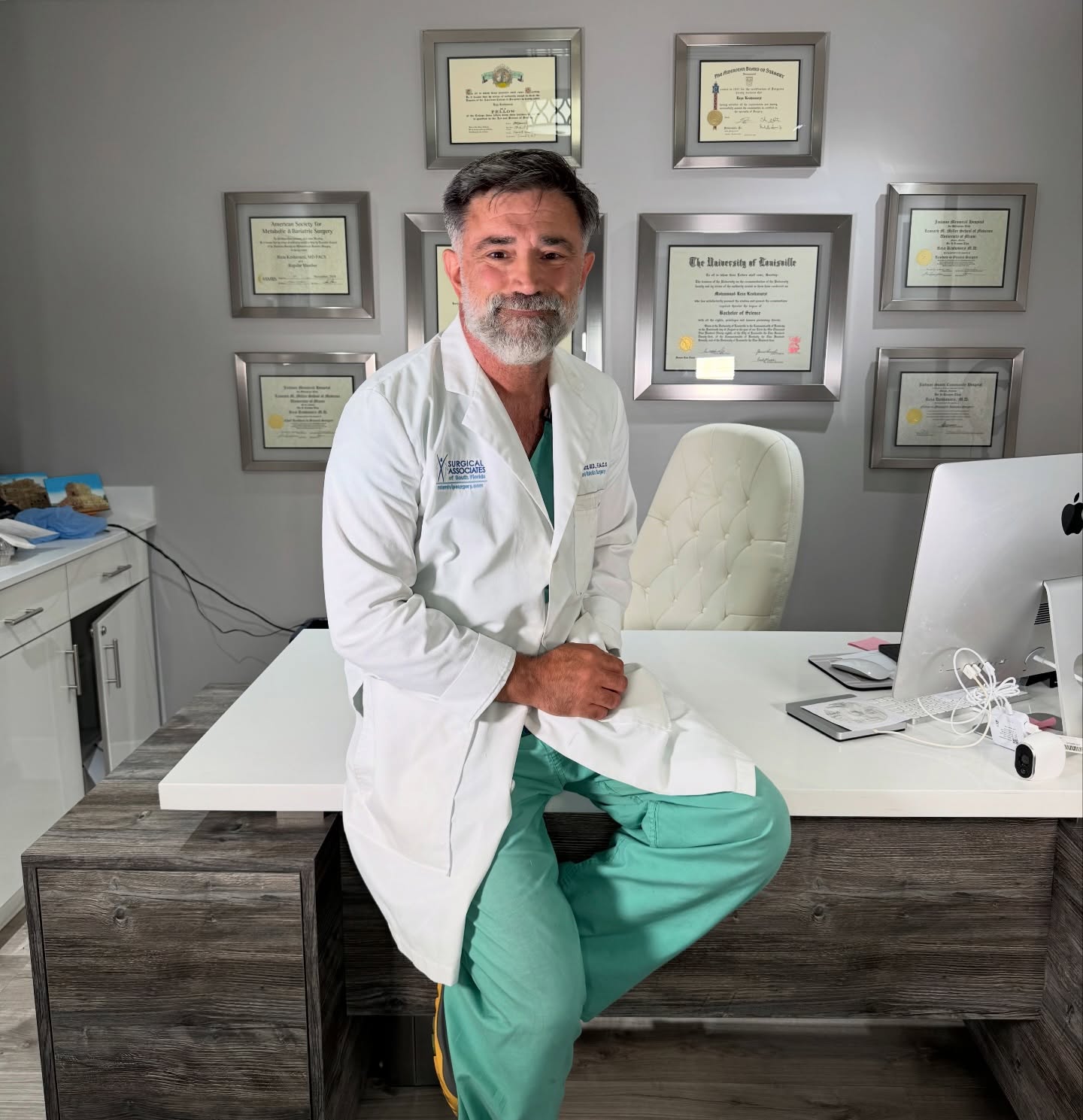
Patients know him as Dr. K. He trained specifically in weight loss surgery, completing his surgical residency at Jackson Memorial Hospital and a fellowship in laparoscopic, bariatric and robotic surgery at Jackson South Medical Center.
He meets you at the consultation, performs your operation and stays your point of contact afterward. Reviewers mention him sharing his cell phone so he could be reached at any hour.
Most of the preparation can happen close to home in Broward County. The drive south matters most on surgery day.
He reviews your health and weight history, explains whether bypass or another option fits, and you leave knowing his recommendation, the reason for it and what your package covers.
Medical clearances and an upper endoscopy are required. Tests can be done at our clinic or a facility near Coral Springs, and an EGD from the past 5 months is accepted.
You follow a pre-surgery diet, and any weight loss injection stops at least two weeks ahead. Once tests are complete, surgery dates are often open within the same month.
Dr. K performs your bypass laparoscopically. You go home after a short hospital stay with clear instructions for the first days.
Our patients typically return to work in 4 to 7 days and avoid lifting over 20 pounds while healing. Meals move from liquids to soft foods to regular plates using our diet plans.
Concierge follow-up, nutrition coaching and psychological support continue after surgery, so new habits hold as the weight comes off.
"He has been there the whole process, provided his cell phone to make sure he could be reached at all hours."
Yesi, Google review
"His timely communication and expert guidance were instrumental in helping me reach my health goals."
Jeff De La Cruz, Google review
"The doctor was very straightforward and honest and extremely professional."
Pat Cutting, Google review
We quote gastric bypass as one package price once Dr. K confirms it is the right procedure for you, so the number reflects your real plan rather than an estimate. Financing spreads that cost over time.
 Cherry financing accepted, with debit and credit cards for any balance
Our office is in South Miami, roughly an hour south of Coral Springs by car depending on traffic. You can keep the trips few: pre-op tests can be done near home, and a recent EGD from another facility counts.
Between visits, our team sends documents and answers next-step questions by text, so questions between visits do not have to wait for an appointment.
Straight answers to what Coral Springs patients ask most before their first visit.
We quote gastric bypass as one package price once Dr. K confirms it is the right procedure for you, so the number matches your actual plan. Financing through Cherry offers 24 months at 0% interest, with monthly payments as low as $320. Debit and credit cards are accepted for any remaining balance.
You can reach our team directly to set up a consultation with Dr. K. If you plan to use an insurance plan, check whether that plan asks for a referral from your primary care doctor before you begin.
It depends on your health, your weight history and your goals, and the answer is often a combination. GLP-1 medications such as Ozempic reduce appetite while you take them, while gastric bypass changes the stomach, the intestine and the hunger hormones they produce. Dr. K builds plans that can use both, and any injection stops at least two weeks before surgery.
Our patients typically return to work 4 to 7 days after surgery and avoid lifting anything over 20 pounds while they heal. Eating moves in stages from liquids to soft foods to regular meals, and our diet plans guide each stage.
No. Required tests can be done at our clinic or at a facility closer to Coral Springs, and an EGD performed within the past 5 months is accepted. Our team also sends documents and answers next-step questions by text between visits.
A sleeve removes most of the stomach and leaves a narrow tube, while a bypass creates a small pouch and reroutes the small intestine. Because bypass also changes absorption and gut hormones, it is often favored for patients with type 2 diabetes or frequent acid reflux. Dr. K performs both and explains which one fits you.
Scheduling speed depends on how quickly your medical clearances and EGD are completed. Once they are done, surgery dates are often available within the same month.
Find out whether bypass, a sleeve or a combined plan fits your health, and leave with a clear next step.